

Shot blasting and painting lines should be planned together by matching the workpiece, required surface cleanliness, surface profile, coating system, drying time and actual production capacity. Selecting each system independently can create bottlenecks, premature rusting and unnecessary operating costs.
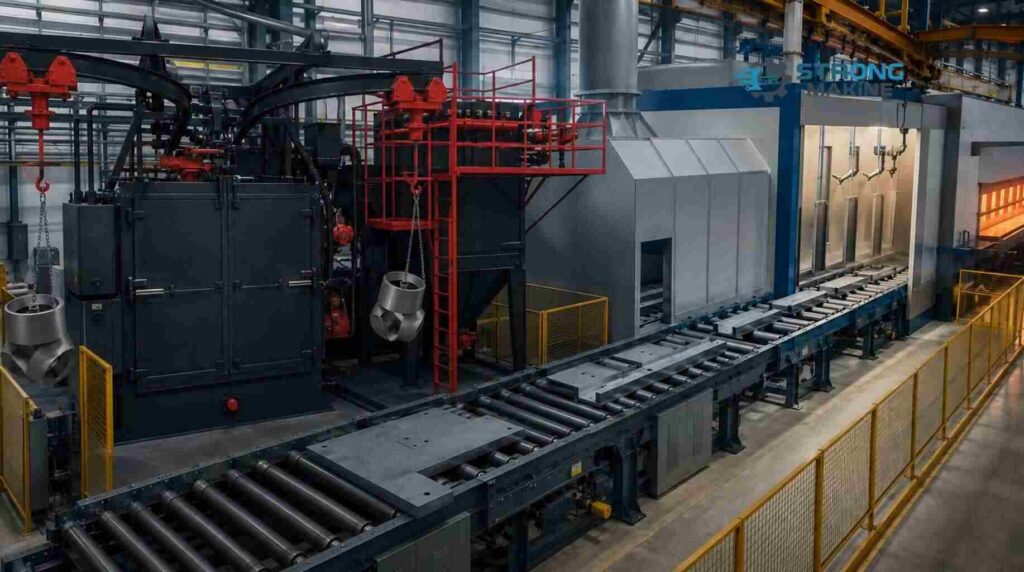
Where Should Shot Blasting and Painting Line Planning Begin?
Planning should begin with the workpiece rather than the machine. Its dimensions, weight, geometry, surface condition and hourly production volume determine the appropriate shot blasting process.
The project data should include:
- Maximum workpiece dimensions and weight
- Hourly or shift production target
- Initial rust, mill scale and coating condition
- Required surface cleanliness grade
- Required surface profile
- Primer and topcoat system
- Flash-off and curing times
- Available floor space
- Ventilation, energy and compressed-air capacity
Visual preparation grades for steel surfaces are classified in ISO 8501-1. Surface roughness should also be assessed according to the relevant ISO 8503 methods and the coating manufacturer’s technical data.
How Is a Hanger Type Shot Blasting Machine Integrated?
A hanger type shot blasting machine is suitable for large, heavy and geometrically complex components. Castings, welded structures, chassis parts and machine bodies rotate inside the chamber while abrasive is projected by turbines.
The hanger capacity should not be selected only by weight. Workpiece orientation, shadowed areas, turbine arrangement and the number of parts loaded on each hanger also affect the cycle time.
Key integration points include:
- Compatibility between blasting and painting carriers
- Balanced loading, blasting and unloading times
- Dust removal before coating
- Minimal manual contact with cleaned surfaces
- Controlled transfer time to the paint booth
If the hanger shot blasting machine is faster than the coating section, work-in-progress inventory accumulates. If painting is faster, the booth waits for parts. Actual cycle times must therefore be compared instead of relying only on nominal machine capacity.
How Does a Rubber Belt Tumble Blasting Machine Fit the Process?
A rubber belt tumble blasting machine processes bolts, nuts, fasteners and small castings in batches. Its flexible belt continuously turns the load so that the abrasive reaches different surfaces.
Because tumble blasting is a batch process, it cannot always be connected directly to a continuous paint line. A buffer, sorting or hanging station may be required between the two systems.
What Should Be Checked in a Tumble Blasting Line?
The project should consider whether parts can strike, lock into or damage one another. A handling method that works during blasting may not provide suitable spacing during painting.
The plan should define:
- Batch weight and blasting time
- Risk of impact or deformation
- Removal of retained abrasive
- Sorting or hanging requirements
- Batch traceability and process recipes
A rubber belt tumble blasting machine is economical for high volumes of small components. Sample testing remains necessary for thin, delicate or interlocking parts.
How Does a Plate and Profile Shot Blasting Machine Set Line Speed?
A plate and profile shot blasting machine continuously processes plates, box sections, beams and other long steel products. It therefore has a direct influence on the speed of an integrated blasting and painting line.
Conveyor speed depends on the required preparation grade, turbine quantity, abrasive flow rate, workpiece width and initial surface condition. Passing through the chamber is not enough; the workpiece must leave the machine with the specified cleanliness and profile.
How Is Conveyor Speed Calculated?
A preliminary capacity calculation can follow this relationship:
Hourly capacity = usable working width × conveyor speed × loading efficiency
The calculated speed must then be verified through production trials. The selected setting should consistently achieve the specified Sa 2½ cleanliness and the surface profile required by the coating manufacturer.
After blasting, the workpiece may pass through dust removal, inspection, painting, flash-off and curing sections. These stations should operate according to the same production rhythm.
Why Is the Time Between Blasting and Painting Important?
Freshly blasted steel has no protective barrier. Moisture, condensation, dust or handling contamination can quickly reduce coating performance.
The line should therefore:
- Keep blasting and painting sections reasonably close,
- Prevent bare-hand contact with cleaned steel,
- Remove dust and residual abrasive,
- Monitor steel temperature and relative humidity,
- Apply paint within the coating manufacturer’s conditions.
There is no universal rule stating that every blasted surface must be painted within a fixed number of hours. The acceptable interval depends on humidity, dew point, steel temperature, contamination and the selected coating system.
Integrated Line vs Separate Machines: Which Is Better?
| Criterion | Integrated line | Separate systems |
|---|---|---|
| Material flow | Controlled and traceable | Requires intermediate handling |
| Surface protection | Lower risk of re-rusting | Longer waiting periods are possible |
| Flexibility | Efficient for similar products | Better for changing product mixes |
| Initial investment | Usually higher | Can be installed in stages |
| Layout | Requires planned linear space | Can use separate production areas |
| Bottleneck risk | High if capacities are mismatched | Sections can operate independently |
An integrated line is generally more efficient for repeatable, high-volume production. Separate systems can be more practical when component sizes, coating specifications or production schedules change frequently.
How Should the Paint Booth and Oven Be Sized?
The paint booth should be based on the actual production mix rather than the maximum output of the blasting machine. Application time, number of coats, colour changes, flash-off periods and curing requirements determine the coating cycle.
Spray areas also require correctly engineered ventilation. OSHA’s spray-painting requirements call for mechanical ventilation capable of controlling vapours, mists and combustible residues during spraying and for a sufficient period afterward. Applicable national fire, electrical and occupational-safety regulations must also be reviewed.
How Does Strong Makine Approach Integrated Line Projects?
Strong Makine develops industrial shot blasting machines and application-specific surface preparation solutions based on its founders’ 20 years of sector experience. The engineering process considers material flow, real cycle time, abrasive recovery, dust collection and the following coating stage.
The selection of a hanger type shot blasting machine, rubber belt tumble blasting machine or plate and profile shot blasting machine should be based on workpiece trials and measurable production data. The objective is not to purchase the largest machine, but to establish a balanced and controllable blasting-and-painting process.
Frequently Asked Questions – FAQ
What information is required to design a blasting and painting line?
Workpiece dimensions, weight, production target, surface condition, required cleanliness, coating system, curing time and plant layout are required.
Should steel be painted immediately after blasting?
Unnecessary waiting should be avoided. The acceptable interval must be determined from humidity, steel temperature, dew point and the coating manufacturer’s data sheet.
Can every shot blasting machine be connected to a paint line?
Many machines can be integrated, but batch and continuous processes require different handling and buffer solutions.
How is an Sa 2½ surface checked?
The surface is visually compared with the descriptions and reference images in ISO 8501-1. Surface profile, dust and soluble salt testing may also be required.
Which section determines the production speed?
The section with the longest actual cycle time determines line capacity. This may be blasting, paint application, colour changing, flash-off or curing.
People Also Ask – PAA
How do you calculate conveyor speed for an integrated blasting and painting line?
Conveyor speed is calculated from the required cleanliness, turbine output, workpiece dimensions, coating time and curing requirements, then confirmed through production tests.
What is the difference between hanger and tumble belt shot blasting machines?
A hanger machine processes large or complex components individually, while a tumble belt machine cleans small parts together in controlled batches.
Why is manganese steel lining used in shot blasting chambers?
Manganese steel work-hardens under repeated abrasive impact, extending the service life of high-wear areas inside the blasting chamber.
Author: Strong Makine Technical Content Team
Expertise: Industrial shot blasting equipment, surface preparation and production-line engineering.
If you enjoyed our article titled “How to Plan Shot Blasting and Painting Lines Together“, visit our News page for more content.
Contact us for information about Strong Makina.