

Shot blasting machine capacity is calculated by combining the part’s weight and size, the target surface cleanliness level (for example Sa 2.5), the cycle time, and the granule throughput of the turbines (kg/min). In its simplest form, capacity equals the amount processed per cycle multiplied by the cycles per hour; the machine type — hanger, tumble, or sheet & profile — directly shapes this calculation.
An accurate calculation prevents both over-investing in an oversized machine and buying an undersized one that bottlenecks production. Below is how capacity works for the three main shot blasting machine types.
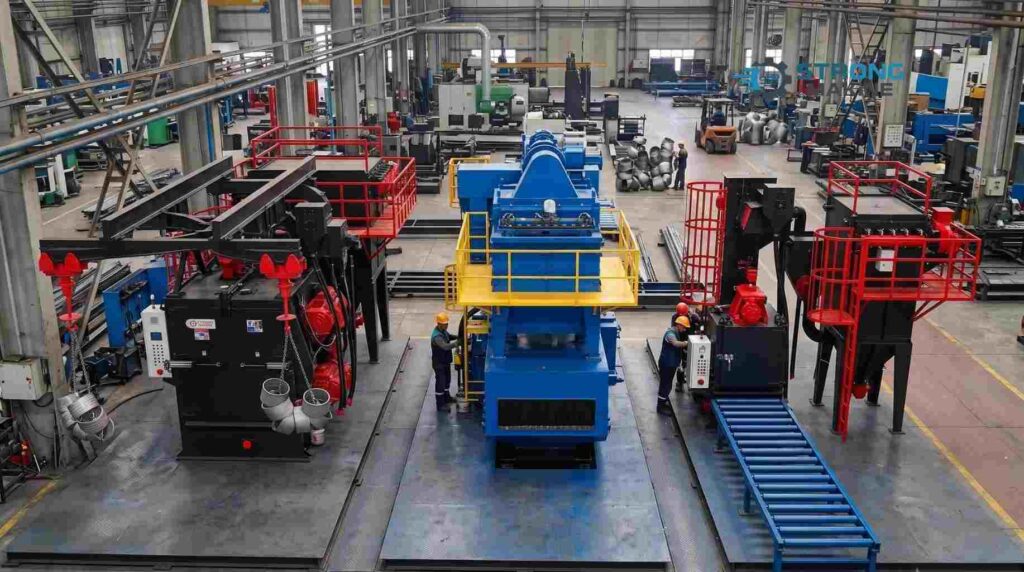
What Is Shot Blasting Machine Capacity?
Shot blasting machine capacity is the amount of parts a machine can process at an acceptable cleanliness level within a given time. It is not a fixed number: the same machine gives higher capacity for light rust and lower capacity for thick mill scale, so it must always be stated with the target cleanliness level.
Which Variables Are Used in the Capacity Calculation?
The main variables that determine shot blasting machine capacity are:
- Part weight and size — how many parts fit into one cycle.
- Target surface cleanliness — Sa 2, Sa 2.5 or Sa 3; drives the time needed.
- Cycle (blasting) time — the time required to clean the surface.
- Number of turbines and granule flow (kg/min) — abrasive hitting the surface per unit time.
- Loading and unloading time — extends the total cycle on batch machines.
As any variable changes, capacity changes: higher turbine granule flow, for instance, reaches the same cleanliness faster and raises hourly capacity.
How to Calculate Hanger Shot Blasting Machine Capacity?
Hanger shot blasting machine capacity equals the load a hanger carries (tons) multiplied by the cycles per hour. These machines use batch logic for large, heavy and complex parts.
The formula is: Hourly capacity (ton/hour) = Hanger load × (60 / total cycle time in minutes). In the Strong Makine AK series, hanger capacity ranges from 0.5 tons (AK-0) to 7.5 tons (AK-5).
| Example (illustrative)On a hanger shot blasting machine with 2-ton capacity, a 10-min blast + 5-min load/unload = 15-min cycle gives 4 cycles/hour, about 8 ton/hour in theory. Real blast time depends on rust/scale thickness and the target Sa level. |
How to Calculate Tumble (Rubber Belt) Shot Blasting Machine Capacity?
Tumble shot blasting machine capacity equals the drum load per batch (kg) multiplied by batches per hour. These machines suit small, bulk parts such as bolts, nuts and small castings.
In the Strong Makine LTK series, drum capacity is 100 kg (LTK-100) and 300 kg (LTK-300), with maximum part weights of 4 kg and 8 kg. Avoid overfilling the drum; excess load makes parts shadow each other and lowers cleaning quality.
How to Calculate Sheet & Profile Shot Blasting Machine Capacity?
A sheet & profile shot blasting machine runs continuously, so capacity is calculated in m²/hour from conveyor speed times pass width. These machines are built for sheet metal, I/H profiles and structural steel.
Formula: Capacity (m²/hour) = Conveyor speed (m/min) × effective pass width (m) × 60. In Strong Makine systems the pass width is typically 1000–3500 mm, and conveyor speed is set to the target cleanliness level.
Capacity rises by increasing conveyor speed or adding turbines — but higher speed means less cleaning time, so speed is limited at high standards such as Sa 2.5.
Hanger vs Tumble vs Sheet & Profile: Capacity Comparison
The three types calculate capacity with different units and logic, summarized below.
| Criterion | Hanger | Tumble | Sheet & Profile | Example |
| Operation | Batch | Batch | Continuous | — |
| Capacity unit | ton/hour | kg/hour | m²/hour | — |
| Ideal part | Large / heavy / complex | Small / bulk | Sheet & profile | — |
| Capacity driver | Hanger load + cycle | Drum load + batch | Conveyor speed + width | — |
| Strong Makine series | AK-0 … AK-5 | LTK-100 / LTK-300 | 1000–3500 mm | — |
What to Watch Out for When Calculating Capacity?
- Always state capacity together with the target cleanliness level.
- Include loading/unloading time in the total cycle; do not count blast time only.
- Leave a scalable reserve margin for future production growth.
- Mind part geometry; the shadow effect reduces capacity.
Choosing the Right Capacity with Strong Makine
Founded in 2023 by a team combining its founders’ 20 years of industry experience, STR Strong Makine is a Konya-based shot blasting machine manufacturer. It offers engineering solutions across three product groups: the hanger shot blasting machine, the tumble shot blasting machine and the sheet & profile shot blasting machine.
The right capacity is defined only by analyzing your part type, production volume and target cleanliness level. Strong Makine’s engineering team projects these variables to size the machine for your line.
Frequently Asked Questions – FAQ
In which unit is shot blasting machine capacity expressed?
Ton/hour or kg/hour for batch machines, and m²/hour or meters/minute for continuous (conveyor) machines.
Which factor affects capacity the most?
The target cleanliness level and turbine granule flow. As the standard rises, cycle time lengthens and hourly capacity drops.
Which machine gives higher capacity for small parts?
A tumble shot blasting machine, thanks to batch processing — ideal for bolts, nuts and small castings.
How is capacity increased for sheet and profile?
Raise the conveyor speed or add turbines on a sheet & profile shot blasting machine; note that speed is limited at high standards such as Sa 2.5.
What information should I prepare for a capacity calculation?
Part weight and dimensions, production volume, current surface contamination and the target Sa level. These define the correct machine type and capacity.
People Also Ask – PAA
What does a shot blasting machine do?
It cleans rust, scale and dirt from metal with high-velocity abrasives, preparing the surface before painting and coating, which improves adhesion and product life.
What does Sa 2.5 mean?
A “very thorough” degree of metallic cleanliness defined in ISO 8501-1 — the most common preparation level before painting.
How does the number of turbines affect capacity?
More turbines throw more abrasive per unit time, shortening cleaning time and raising capacity. The Strong Makine AK series has 2 to 6 turbines.
Author: Strong Makine Technical Content Team — shares knowledge on shot blasting machines and industrial surface preparation. For surface cleanliness levels, refer to the ISO 8501-1 (Sa 2.5) standard.
If you enjoyed our article titled “How to Calculate Shot Blasting Machine Capacity?“, visit our News page for more content.
Contact us for information about Strong Makina.