

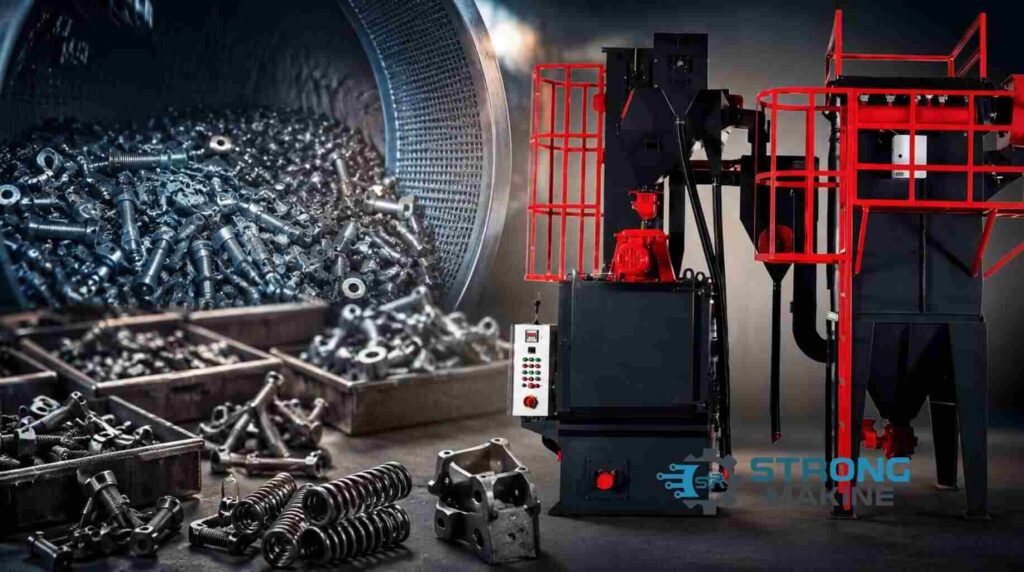
A tumble shot blasting machine is used in the automotive supplier industry to clean rust, scale and burrs from high-volume small parts — bolts, nuts, brackets, springs and small castings — in bulk. Parts tumble gently inside a flexible rubber belt while turbines throw steel shot that cleans every surface uniformly.
This article explains how the machine works, which parts it suits, and how it differs from a hanger system — clearly and to the point.
What is a tumble shot blasting machine?
A tumble shot blasting machine is a surface-preparation unit designed to clean small and medium parts in bulk. At its core is a drum (belt) made of perforated, high-abrasion-resistant rubber.
Parts are loaded into the drum in bulk; as it rotates, every surface is exposed to the abrasive for an equal time. The perforated structure lets the spent shot filter into the lower hopper and return through the recovery system for reuse.
STR Strong Makine offers two models in this class: the LTK-100 with a 100 kg drum capacity and the LTK-300 with 300 kg. The LTK-100 handles single parts up to 4 kg, and the LTK-300 up to 8 kg.
Why do automotive suppliers prefer tumble shot blasting?
Automotive suppliers produce fasteners, small castings and pressed parts by the thousands. Processing them one by one is slow and costly. A tumble shot blasting machine processes them in bulk, giving three core advantages:
- High throughput: A single operator completes many parts quickly through a load-unload cycle.
- Uniform surface quality: Continuous tumbling exposes each part to the abrasive for an equal time.
- Low operating cost: Closed-loop shot recovery reduces abrasive consumption.
A clean surface before painting directly affects coating adhesion. Cleanliness is defined by Sa grades in ISO 8501-1, while surface roughness (profile) is a separate standard (ISO 8503). For the fundamentals, see abrasive blasting.
How does a tumble shot blasting machine work?
The working principle is a simple but effective closed loop:
- Parts are loaded into the perforated rubber drum in bulk.
- The drum rotates slowly and continuously, gently tumbling the parts.
- The turbine throws steel shot onto the parts at high velocity.
- The shot filters through the perforated drum into the lower hopper.
- The elevator collects the shot, the separator removes dust, and it returns to the turbine.
This loop keeps the abrasive in continuous reuse and draws dust through a jet-pulse filter, giving both a clean working environment and a stable process quality.
Which automotive supplier parts are blasted?
Tumble shot blasting is ideal for small and medium parts that are relatively resistant to deformation:
- Fasteners: bolts, nuts, screws, washers
- Small cast and forged parts: brackets, clamps, flanges
- Springs and pressed sheet-metal parts
- Parts needing scale (oxide layer) removal after heat treatment
For very fine-threaded, fragile or large single parts, a hanger system is more suitable than a tumble drum.
Tumble or hanger shot blasting?
The right choice depends on part size and volume. The table below compares the two systems:
| Criterion | Tumble | Hanger |
|---|---|---|
| Part size | Small–medium, in bulk | Large, heavy, single |
| Max part weight | 4–8 kg (LTK series) | Tons (AK series) |
| Loading | Bulk | One by one on a hook |
| Typical part | Bolt, bracket, spring | Chassis, axle, big casting |
| Ideal scenario | High-volume series | Large single parts |
| Field note: A recurring industry principle is that “you pick the machine for the part, not the part for the machine.” A hanger system is slow for high-volume small parts, while a tumble drum struggles with large single ones. Correct matching lowers both cycle time and scrap rate. |
Frequently Asked Questions – FAQ
Which parts is a tumble shot blasting machine suitable for?
It suits small and medium parts that can be processed in bulk; bolts, nuts, brackets, springs and small castings are typical examples.
Does the rubber drum damage parts?
The flexible rubber drum cushions impact compared with hard metal surfaces and reduces deformation risk. Still, very fragile or fine-threaded parts should be assessed on their own characteristics.
What is the difference between LTK-100 and LTK-300?
The LTK-100 has a 100 kg drum capacity and a 4 kg maximum part weight; the LTK-300 has a 300 kg drum capacity and an 8 kg maximum part weight.
Which abrasive is used?
Steel shot is generally used; the closed-loop system collects, cleans and reuses it.
Why is tumble shot blasting suited to automotive suppliers?
Because it processes high-volume small parts in bulk and uniformly, it matches series-production tempo and lowers labor cost.
People Also Ask – PAA
What is the price of a tumble shot blasting machine?
Price varies with capacity, number of turbines and automation level. Contact STR Strong Makine for a project-specific quote.
Is tumble shot blasting the same as vibratory finishing?
No. Tumble shot blasting removes rust and scale with steel shot; vibratory finishing is generally for deburring and surface polishing.
Does it remove sand residue from small castings?
Yes. Sand and burr residues after casting are effectively removed by tumble shot blasting.
Author / Expertise
This content was prepared by the STR Strong Makine Engineering Team. Founded in 2023, STR Strong Makine produces hanger shot blasting, tumble, and sheet & profile shot blasting machines, drawing on its founders’ roughly 20 years of surface-treatment experience.
If you enjoyed our article titled “Use of Tumble Shot Blasting Machine in the Automotive Supplier Industry“, visit our News page for more content.
Contact us for information about Strong Makina.