

Sheet metal is shot blasted before painting to remove rust, mill scale, and contaminants from the steel and to create a rough surface profile that the paint can grip. Together, these give the coating strong adhesion and make the finished product far more resistant to corrosion.
What Is Sheet Shot Blasting?
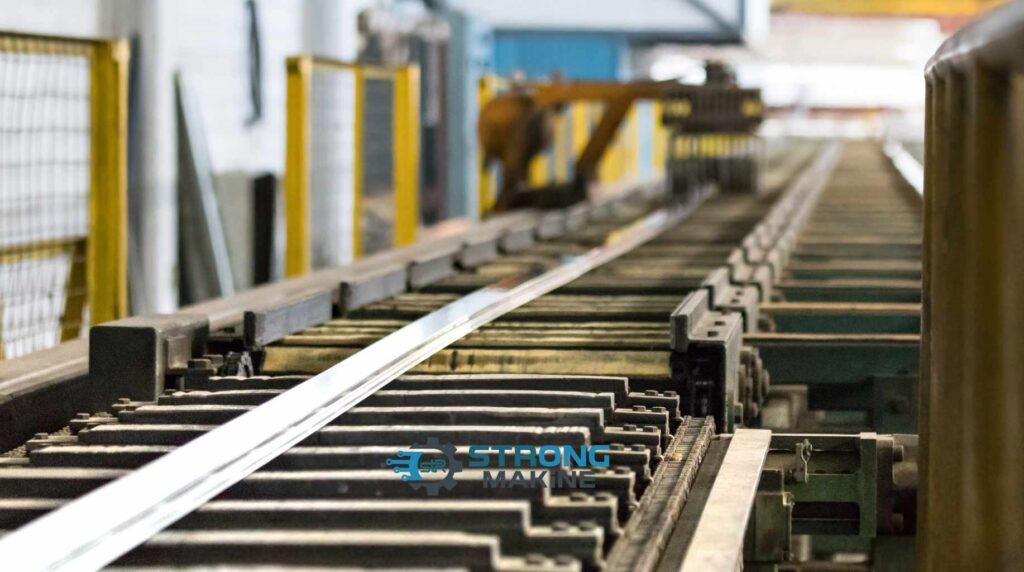
Shot blasting propels steel shot or grit at high velocity against the surface, cleaning and roughening it at the same time. On sheet and profile blasting machines this runs as a continuous (conveyor) process, so plates and profiles are treated in a single pass.
Why Is Blasting Before Painting Essential?
Blasting before painting has two core goals: to clean the surface and to create the profile the paint anchors into. The reasons are:
- Surface cleanliness: rust, mill scale, oil, and weld slag block paint from bonding to steel. Loose mill scale later flakes off on its own and takes the coating with it.
- Surface profile: blasting creates a peak-and-valley anchor pattern that the paint mechanically locks into.
- Corrosion resistance: on a properly prepared surface the coating lasts far longer and early corrosion is prevented.
As a result, even a premium coating over poorly prepared steel fails sooner than a basic coating over a well-blasted surface. That is why surface preparation is the most critical step of the painting process.
What Is the Sa 2.5 Cleanliness Standard?
The cleanliness reached by blasting is graded under the international ISO 8501-1 standard as Sa 1, Sa 2, Sa 2.5, and Sa 3. For painting, sheet and profile blasting usually targets Sa 2.5 (“near-white metal”), where almost all rust and mill scale has been removed.
How rough the surface is — the profile depth — is measured as Rz under ISO 8503. The right profile keeps the paint from sitting on a surface that is either too smooth or too deep, delivering ideal adhesion.
Shot Blasting vs Manual Surface Cleaning
The two methods most often compared for pre-paint preparation are machine shot blasting and manual (grinding/sanding) cleaning. The table below summarizes the key differences:
| Criterion | Shot Blasting (Steel Shot/Grit) | Manual Cleaning (Grinding/Sanding) |
|---|---|---|
| Cleanliness reached | Up to Sa 2.5 | Usually St 2–St 3 (lower) |
| Surface profile | Uniform anchor pattern | Irregular and limited |
| Speed / capacity | High, continuous conveyor | Slow, labor-intensive |
| Consistency | Standardized | Operator-dependent |
| Large sheets & profiles | Ideal | Difficult and inefficient |
Manual cleaning suits small repairs or spots where blasting is not possible. For mass production and large sheets and profiles, shot blasting is clearly ahead on speed, consistency, and surface quality.
| 💬 Frequently Debated“Can good paint make up for poor surface prep?” No. A basic coating over a well-blasted surface outlasts a premium coating over a poorly prepared one. That is why the budget for surface preparation comes before the paint budget. |
Where Is Sheet Shot Blasting Used?
Sheet and profile blasting is a critical step in almost every heavy-industry field that uses structural steel:
- Steel construction: pre-paint preparation of I/H profiles and plates in building, bridge, and stadium frames.
- Shipbuilding: preparing hull sheets and profiles against seawater corrosion.
- Pipeline and tank fabrication: cleaning pipe and tank plates before welding and coating.
- Wagon and trailer production: surface preparation of chassis and body steelwork.
- Machinery manufacturing: relieving surface tension on machined bodies and parts.
Pre-Paint Preparation with the Strong Makine Sheet & Profile Blasting Machine
Strong Makine’s conveyor-type sheet and profile shot blasting machines prepare plates and profiles to Sa 2.5 in a single pass. With abrasion-resistant manganese-steel liners, a fully automatic abrasive recovery system, and a high-efficiency jet-pulse filter unit, they deliver both high capacity and a clean working environment.
Standard pass width runs from 1000 mm to 3500 mm, with custom engineering available for your facility. For sheet shot blasting, profile shot blasting, and conveyor (tunnel-type) machine solutions, contact the Strong Makine engineering team.
Frequently Asked Questions – FAQ
Why is sheet metal shot blasted before painting?
For paint to bond strongly and last, the surface must be cleared of rust and mill scale and given a profile the paint can grip. Blasting does both at once.
What does Sa 2.5 mean?
Sa 2.5 is the “near-white metal” cleanliness grade in ISO 8501-1. At this level almost all rust and mill scale is removed, leaving an ideal base for paint.
What happens if steel is painted without blasting?
Paint over mill scale and rust soon blisters, cracks, and peels. The mill scale underneath eventually flakes off, taking the coating with it, and corrosion sets in quickly.
What abrasive is used in sheet shot blasting?
The most common abrasives are steel shot and steel grit. Shot leaves a rounder surface, grit a sharper profile; the choice depends on the cleanliness and profile depth required.
Why must mill scale be removed?
Mill scale is an oxide layer formed during hot rolling that clings loosely to the surface. Left under paint, it eventually detaches, so it must be removed by blasting before coating.
Questions Our Visitors Ask – PAA
How does a sheet shot blasting machine work?
Sheets and profiles move on a conveyor while turbines inside the cabin throw steel abrasive at high velocity, cleaning every surface in a single pass.
What is a profile shot blasting machine for?
It cleans rust and mill scale from structural steels such as I/H profiles and angle irons and creates the ideal profile before painting.
What is a conveyor (tunnel-type) shot blasting machine?
It is a machine that passes material continuously through the blasting cabin on a roller conveyor, giving high capacity for large-volume and mass production.
What surface profile is needed before painting?
As a general rule the surface profile (Rz) should be roughly one-quarter to one-third of the primer’s dry film thickness; the exact value depends on the coating system.
Content Author:
This content was prepared by the STR Strong Makine engineering team, which brings together its founders’ 20 years of surface-treatment experience. The company manufactures hanger, rubber-belt tumble, and sheet & profile shot blasting machines, providing solutions for industrial surface preparation.
Sources:
If you enjoyed our article titled “Why Is Sheet Metal Shot Blasted Before Painting?“, visit our News page for more content.
Contact us for information about Strong Makina.