

The hanger system is preferred in shot blasting because it applies abrasive uniformly to every surface of large, heavy, and geometrically complex parts, leaving no blind spots. As the workpiece rotates on its hook inside the cabin, steel shot propelled by the turbines reaches all surfaces equally. Parts that would collide in a tumble drum, or that are simply too large for one, are cleaned safely.
In this article, you will find how a hanger shot blasting machine works and why it outperforms alternative methods, based on the 20+ years of surface-treatment experience behind the STR Strong Makine engineering team.
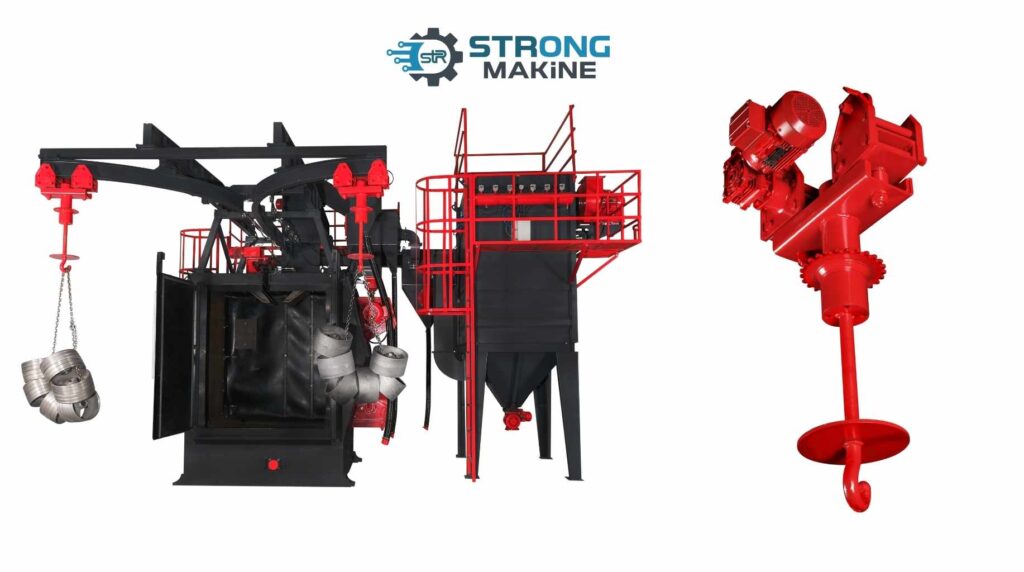
What Is a Hanger Shot Blasting Machine?
A hanger shot blasting machine is an industrial surface-treatment system in which workpieces are suspended on hooks and cleaned inside a closed cabin with abrasives such as steel shot or grit. A hanger type shot blasting machine removes rust, mill scale, welding slag, and residual foundry sand, creating the ideal surface roughness before painting and coating.
The Strong Makine AK series covers a wide capacity range, from the AK-0 with a 900 mm basket diameter to the AK-5 with a 2250 mm basket diameter. Hook capacity extends from 0.5 tons up to 7.5 tons depending on the model, so heavy castings and large structural components can be processed as single pieces.
How Does the Shot Blasting Machine Process Work in a Hanger System?
The hanger shot blasting machine process is based on rotating the part on its hook while it is bombarded by turbines. The cycle runs in five steps:
- 1. Loading: Parts are loaded onto a monorail or Y-type hanger system.
- 2. Rotation: The hanger carries the part into the blasting cabin and rotates it on its own axis.
- 3. Blasting: High-speed turbines project the abrasive onto the surface; granule flow in the AK series ranges from 100 to 240 kg per minute depending on the model.
- 4. Recovery: Used abrasive is collected by the elevator, cleaned in the separator, and returned to the turbines.
- 5. Dust collection: A Jet-Pulse filter unit captures dust, keeping the working environment clean and safe.
This closed loop minimizes both abrasive consumption and operator intervention in an automatic hanger type shot blasting machine.
What Are the Advantages of the Hanger System?
- Uniform cleaning: The rotating hook eliminates the shadow effect, so abrasive reaches recesses, undercuts, and internal pockets.
- Part safety: Parts never touch each other, so heavy components with delicate surfaces are processed without damage.
- High capacity: With hook capacities up to 7.5 tons, the system handles sizes and weights no tumble machine can.
- Line integration: Monorail and Y-type hanger tracks integrate the machine directly into paint and coating lines.
- Low operating cost: Manganese steel cabin liners and energy-efficient turbines reduce maintenance frequency and running costs.
Standardized quality: The Sa 2.5 cleanliness grade targeted for coating adhesion is achieved repeatably, as defined in ISO 8501-1.
Which Parts Are Suitable for the Hanger System?
- Large, heavy castings such as engine blocks, pump and gearbox housings
- Welded steel structures and profiles
- Automotive components such as chassis, axles, and wheels
- Machined machine bodies and fixtures
- Forged parts requiring scale removal after heat treatment
Hanger or Tumble Shot Blasting: Which One Should You Choose?
Short answer: part size and sensitivity decide. Large, heavy, individual parts belong on a hanger system; small bulk parts such as bolts and nuts belong in a rubber-belt tumble machine.
Hanger system — pros and limits:
- Pro: Very wide size and weight range; parts are processed without collision.
- Pro: Integrates into conveyor lines for continuous flow.
- Limit: Parts must be hung individually, so it is slower than a tumbler for thousands of small parts.
Tumble system — pros and limits:
- Pro: Fast, economical bulk processing of small parts.
- Limit: Part size and weight are restricted; in the Strong Makine LTK series, the maximum part weight is 8 kg.
Which Industries Use Hanger Shot Blasting Machines?
- Foundries: Removal of foundry sand and burrs from castings
- Steel construction: Pre-paint preparation of structural steel for buildings and bridges
- Automotive: Descaling of chassis, axles, and engine blocks
- Machinery manufacturing: Surface standardization of machined bodies
- Forging and heat treatment: Scale removal after heat treatment
| Insight from the Industry FloorIn professional manufacturing forums such as Practical Machinist and Foundry Management, veteran plant managers agree on one point: a cheap shot blasting machine ends up costing more, because downtime from frequent liner replacements and turbine failures outweighs the initial savings. The two criteria they look for are manganese steel liners and balanced turbines. |
Frequently Asked Questions – FAQ
Which abrasives are used in a hanger shot blasting machine?
The most common abrasives are steel shot and angular steel grit. The choice depends on the part material, the type of contamination, and the target surface roughness.
How many tons can a hanger shot blasting machine carry?
In the Strong Makine AK series, hook capacity ranges from 0.5 to 7.5 tons depending on the model, with the AK-5 processing up to 7.5 tons on a single hook.
Do blind spots remain in a hanger system?
No. The rotation of the part on its hook, combined with engineered turbine angles, eliminates the shadow effect even on recessed and complex geometries.
Is a hanger shot blasting machine difficult to maintain?
No. The cabin interior is lined with abrasion-resistant manganese steel, which work-hardens under impact and extends service life.
Can an automatic hanger type shot blasting machine be integrated into an existing line?
Yes. Monorail and Y-type hanger tracks allow the machine to run in sync with existing conveyor and paint lines.
People Also Ask – PAA
What determines the hanger type shot blasting machine price?
The main factors are basket diameter, hook capacity, the number and power of turbines, filter capacity, and project-specific automation requirements.
Is buying a second-hand hanger shot blasting machine a good idea?
Without knowing the liner wear, turbine balance, and filter condition, a used machine carries a serious downtime risk; evaluate total cost of ownership, not just the purchase price.
What does the Sa 2.5 cleanliness grade mean in shot blasting?
Sa 2.5 denotes very thorough blast cleaning according to ISO 8501-1. It is the most commonly targeted preparation grade for strong coating adhesion.
How does hanger blasting differ from tumble blasting?
In hanger blasting, parts are processed individually on hooks; in tumble blasting, parts roll together in bulk. That is why the hanger system suits large, delicate parts, while the tumbler suits small mass-produced parts.
About the Author: This content was prepared by the STR Strong Makine engineering team. Built on its founders’ 20 years of sector experience, Strong Makine designs and manufactures hanger, rubber-belt tumble, and sheet & profile shot blasting machines through its in-house R&D department.
If you enjoyed our article titled “Why Is the Hanger System Preferred in Shot Blasting?“, visit our News page for more content.
Contact us for information about Strong Makina.