

Maintenance Periods for Hanger Shot Blasting and Tumble Shot Blasting Machines, Strong Makine Shot Blasting Machine Maintenance Guide
To ensure that shot blasting machines operate with high efficiency and extend their operational life, daily, weekly, and monthly periodic maintenance must be performed without interruption. The fundamental requirement for achieving uninterrupted performance in industrial surface preparation is the regular inspection of turbines, liners, and filter systems exposed to abrasive wear.
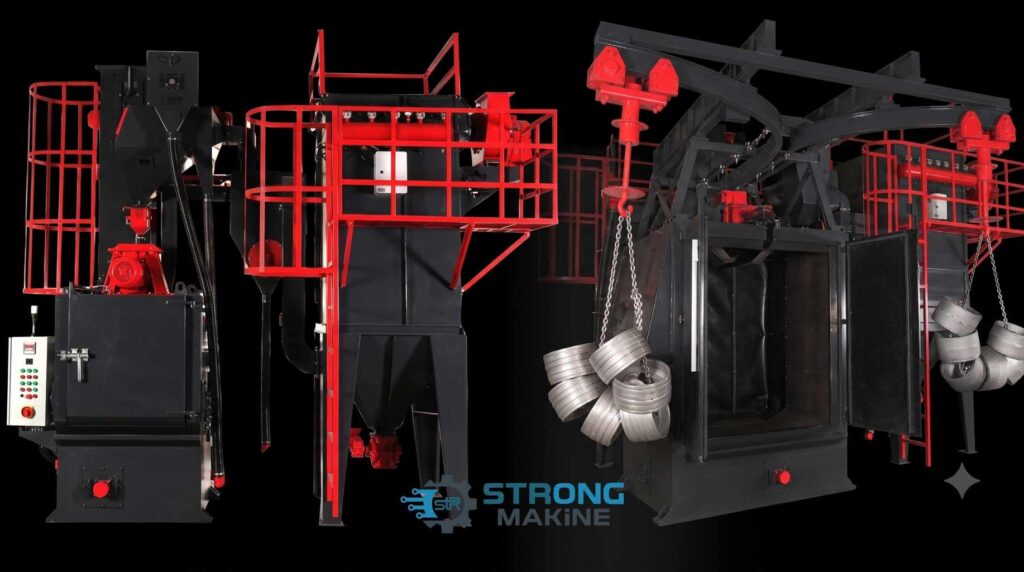
Guiding surface preparation technologies with 20 years of sector experience, Strong Makine has prepared this comprehensive maintenance guide to minimize downtime in industrial production lines. If you use a hanger shot blasting machine equipped with high-performance turbine technology or optimized tumble shot blasting machines for delicate bulk parts, implementing the following periodic steps will significantly reduce your total cost of ownership.
How to Maintain a Hanger Shot Blasting Machine?
A hanger shot blasting machine (Hanger Type Sandblasting Machine) is used for the surface cleaning of large, heavy, and complex geometric workpieces. Since the parts are rotated around their own axis inside the cabin via a hanger system and subjected to continuous blasting, the maintenance focus is directly placed on internal protective elements and mechanical rotating components.
Daily Maintenance Steps
- Internal Protective Liners: The manganese steel liners inside the cabin, which possess high wear resistance, must be inspected visually. If there is perforation or extreme thinning in the liner plates, immediate action must be taken to protect the main body.
- Turbine Blades and Directional Elements: The wear condition of the blades, distributors, and control cages inside the turbine must be examined. Worn blades distort the abrasive projection angle and degrade surface preparation quality.
- Abrasive (Granule) Level: The amount of steel shot or grit in the storage hopper must be checked, and refills must be made in appropriate sizes if depleted.
Weekly and Monthly Maintenance Steps
- Elevator and Conveyor Belts: The tension of the bucket elevator, bucket connection bolts, and the wear condition of the screw conveyors must be verified.
- Jet-Pulse Filter System: The compressed air cleaning system of the filter cartridges or bags must be inspected, and the sealing integrity of the dust collection unit must be tested.
- Hanger Rotation Mechanism: The bearings and rotation motor gears of the monorail or “Y” type hanger system must be lubricated regularly.
How to Maintain a Tumble Shot Blasting Machine?
Providing damage-free and homogeneous cleaning for small and medium-sized bulk parts (bolts, nuts, washers, small castings, etc.), rubber belt tumble shot blasting machines feature an elastic rubber belt mechanism. In these machines, maintenance processes concentrate heavily on protecting the rubber belt and the abrasive filtration system.
Daily Maintenance Steps
- Rubber Belt Inspection: The perforated rubber belt where parts tumble must be checked for cuts, tears, or excessive wear. A torn rubber belt causes abrasives to leak outside the cabin and leads to jams in mechanical components.
- Cleaning Belt Perforations: The granule drainage holes on the rubber belt must be checked for blockages, and trapped burrs must be cleared out.
- Door Sealing Gaskets: The integrity of the anti-wear rubber gaskets on the cabin’s front loading door must be examined.
Weekly and Monthly Maintenance Steps
- Drive Chains and Rollers: The roller bearings and chain-gear mechanisms that turn the belt must be inspected and lubricated with high-temperature-resistant grease.
- Air-Wash Separator: The airflow of the separator unit, which sifts dust and burrs away from the reusable steel shots, must be checked, and the separator screens must be cleaned.
Hanger Shot Blasting vs Tumble Shot Blasting: Maintenance Comparison
To understand which machine type is more advantageous for your facility along with its specific maintenance dynamics, you can review the comparison matrix below:
| Maintenance Criterion | Hanger Shot Blasting Machine | Tumble Shot Blasting Machine |
| Internal Cabin Wear Focus | Manganese Steel Wall Liners | Perforated Rubber Belt / Apron |
| Mechanical Risk Factor | Hanger Bearings and Rotation Motors | Belt Drive Chains and Support Rollers |
| Ease of Maintenance | Easy due to spacious internal cabin access | Demands tight-space intervention due to compact layout |
| Abrasive Media Loss Risk | Low (Enclosed Monorail Sealing Protection) | Medium (Door Gasket and Belt Edge Wear Over Time) |
| Workpiece-Induced Wear | Localized impact damage from heavy structural components | Homogeneous surface wear caused by continuous tumbling friction |
Advantages and Disadvantages
- Hanger Shot Blasting:
- Pros: Parts do not collide with each other, meaning fragile or massive geometries are never damaged. Maintenance relies mostly on localized part-by-part replacements.
- Cons: Due to a higher number of turbines (up to 6 units in large AK-5 models), total turbine blade maintenance budgets are higher.
- Tumble Shot Blasting:
- Pros: It features a compact design, takes up minimal floor space, and motor maintenance is highly economical since it generally utilizes a single turbine (LTK series).
- Cons: Heavy workpieces or sharp-edged casting burrs can tear the rubber apron rapidly, requiring periodic belt replacements.
Why Invest in Strong Makine Surface Treatment Assets?
In surface preparation workflows, ongoing operational and maintenance outlays impact long-term profitability just as much as the initial capital investment. At Strong Makine, we merge industrial excellence with economical running criteria in every model we forge.
- High Durability & Affordable Solutions: We enforce premium Manganese Steel liners across internal cabin strike areas. This material work-hardens automatically under continuous abrasive blasting impact. Consequently, maintenance cycles are stretched out, lowering operational overhead significantly compared to competitors.
- Minimum Energy, Maximum Flow: Leveraging our energy-efficient balanced turbine motors and engineered blade placement angles, your lines reach higher kg/min abrasive flow streams while consuming less electricity.
- Second-Hand Trade and Complete Overhaul Support: Alongside new machinery production, we back cost-conscious buyers looking into used shot blasting machines with technical valuation, brokerage, and absolute rebuilding support. We restore idle machinery to factory performance using genuine spare parts.
Frequently Asked Questions – FAQ
What happens if shot blasting machine maintenance is neglected?
If maintenance is skipped, turbine blades wear out first, rendering it impossible to capture standard Sa 2.5 surface roughness profiles. If internal protective liners get perforated, high-velocity abrasive streams drill through the main chemical cabinet housing, triggering irreversible structural failure and highly expensive plant shutdowns.
What is the lifespan of manganese steel liners?
The lifespan of manganese steel liners relies on the type of abrasive media used (steel shots vs sharp grit), running blasting pressures, and total daily operating hours. Strong Makine’s premium manganese liners provide 4 to 5 times longer lifespans than mild steel or standard rubber sheets.
What parameters should be checked when buying a used shot blasting machine?
Priority should be given to checking structural deformation on the main cabin, wear on the main turbine bearings, and the remaining volumetric capacity of the dust collector system. Strong Makine eliminates risks by providing automated testing and rebuild services during second-hand procurement.
When should Jet-Pulse filter cartridges be replaced?
Cartridges must be swapped out when the filter’s differential pressure gauge passes factory limits and the automatic purging valves fail to clear collected dust cakes. Clogged filters restrict visibility within the cabin and violate safety standards.
Does abrasive granule size alter machinery wear rates?
Yes, it does. Implementing large or excessively angular abrasive grain profiles (such as steel grit) that mismatch your workpiece geometries accelerates wear on turbine components and interior liners. You can receive guidance on media selection from our engineering desk.
People Also Ask – PAA
How often do shot blasting turbine blades need to be replaced?
Turbine blade operational life ranges between 100 to 300 blasting hours on average. Sharp steel grit quickens wear, while round steel shots prolong blade life. Blades must be swapped out as a unified balanced set when surface grooving is noticed during daily checks.
What triggers a rubber tumblast apron to tear prematurely?
Exceeding the max workpiece weight parameters of a tumble shot blasting machine (e.g., individual items over 4 kg for the compact LTK-100 model) or loading casting parts with un-debured, sharp edges causes the rubber apron to slice and tear under tumbling weight.
Why are steel shots preferred over low-grade alternatives?
Spherical steel shots possess high impact elasticity and can be recycled thousands of times before fracturing. This closed-loop configuration, combined with Strong Makine’s integrated separation mechanics, slashes ongoing media consumption expenses dramatically.
If you enjoyed our article titled “Maintenance Periods for Hanger and Tumble Shot Blasting Machines“, visit our News page for more content.
Contact us for information about Strong Makina.