

There are dozens of companies selling tumble shot blasting machines. How many actually manufacture them? How many document their belt material specifications in the contract? How many can supply spare parts from domestic stock when a breakdown occurs?
These are the questions that buyers learn to ask after paying the price of a wrong choice. STR Strong Makine was established in 2023 in Konya, Turkey, converting its founders’ 20 years of engineering experience into active production. With LTK-100 and LTK-300 models, it has positioned itself among Turkey’s reliable domestic rubber belt tumble shot blasting machine manufacturers.
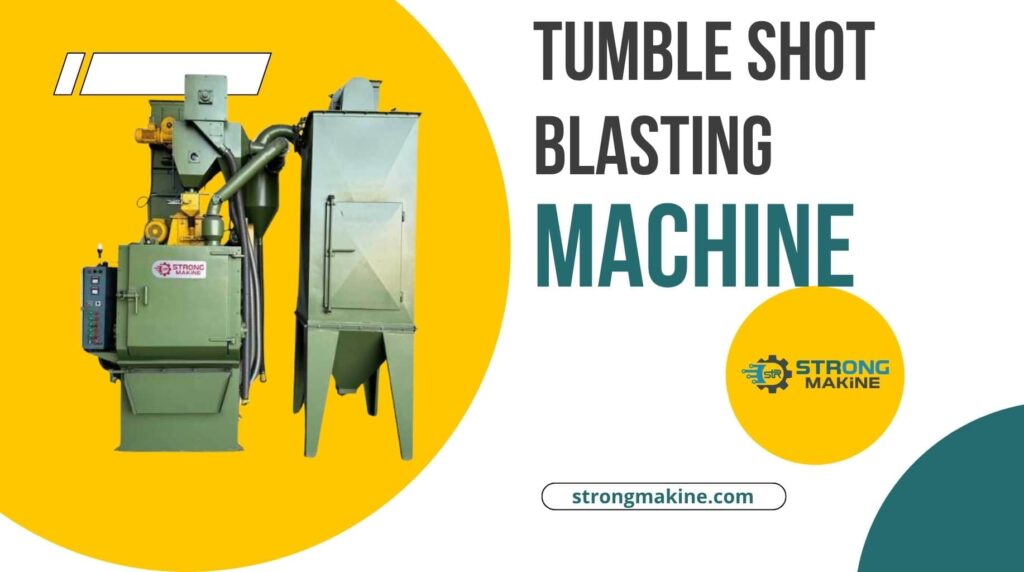
What Should You Look for When Choosing a Tumble Shot Blasting Machine Manufacturer?
Belt Quality: The Real Reason Behind the Price Difference
Why Is the Rubber Hardness Value Critical?
The most overlooked parameter in tumble shot blasting machine purchasing is the rubber belt hardness value. A belt that is too soft deforms quickly — parts pile up instead of tumbling. A belt that is too hard transmits impact — delicate geometries are damaged.
A genuine tumble shot blasting machine manufacturer presents the belt rubber’s hardness and wear resistance values in documented form within the quotation. A company that cannot provide this documentation is a reseller, not a manufacturer.
STR Strong Makine LTK series belts are manufactured with an optimized hardness-flexibility balance. The LTK-100 serves workshop-scale operations with its Ø550 mm diameter, 600 mm drum; the LTK-300 with Ø700 mm diameter and 800 mm length is the standard for high-volume mass production lines.
Turbine Power and Granule Flow: What Is the Real Capacity?
LTK-100 vs LTK-300 Comparison
In automatic tumble shot blasting systems, drum capacity alone is not a sufficient criterion. Turbine power and granule flow determine the machine’s real output per unit time.
The LTK-100 delivers 100 kg/min granule flow with its 5.5 kW turbine motor; the LTK-300 reaches 130 kg/min flow with a 7.5 kW motor. This difference directly impacts hourly production capacity. For facilities processing bolt shot blasting or small castings, the LTK-100 is sufficient. For high-tonnage serial production, the LTK-300 is the correct model.
Industry Forum Debate: “Can Angular Grit Be Used in a Rubber Belt Tumble Shot Blasting Machine?”
This question — recurring for years in Turkish industrial production forums among rubber belt tumblast sandblasting machine operators — continues to cause serious financial losses:
“We switched to angular grit to reduce abrasive costs. Within three weeks the belt was perforated. The seller said ‘outside warranty scope.’ Nobody told us.”
This experience has been reported dozens of times across forums. The answer is clear and unchanging:
Only spherical steel shot is used in rubber belt tumble shot blasting machines. Angular grit rapidly cuts and perforates the elastic rubber surface. Both the belt and the parts are damaged. Contamination of the abrasive recycling system also becomes inevitable.
If you need to use angular grit, a steel belt tumble model must be chosen. However, in this case the risk of part damage increases — it is not suitable for delicate or geometrically complex components.
STR Strong Makine documents abrasive selection in writing according to the customer’s part profile during the quotation phase.
STR Strong Makine Tumble Shot Blasting Machine Technical Data
LTK Series: Two Models, Clear Application Distinction
Which Model for Which Production?
| DESCRIPTION | SYMBOL | LTK-100 | LTK-300 |
|---|---|---|---|
| Drum Capacity | kg | 100 | 300 |
| Max Weight of Parts | kg | 4 | 8 |
| Diameter of Drum | Ø mm | 550 | 700 |
| Length of Drum | mm | 600 | 800 |
| Turbine Diameter / Number of Pallets | Ø mm | 320 – 6 | 320 – 6 |
| Number of Turbines | Pcs. | 1 | 1 |
| Turbine Motor / Rotation | kW / rpm | 5.5 / 3000 | 7.5 / 3000 |
| Fan Air Flow | m³/h | 750 | 2200 |
| Turbine Granule Flow | kg/min | 100 | 130 |
| Drum Turning Motor | kW / rpm | 1.1 / 1500 | 1.1 / 3000 |
| Elevator Motor | kW / rpm | 1.1 / 1500 | 1.5 / 1500 |
| Filter Capacity / Type | m² / type | 22 / Cartridge | 18 / Bag |
| Fan Power | kW / rpm | 1.1 / 3000 | 1.5 / 3000 |
| Width of Machine | mm (+500) | 2200 | 5000 |
| Depth of Machine | mm (+500) | 2500 | 2850 |
| Height of Machine | mm (+500) | 3000 | 3750 |
| Total Electric Power | kW | 10 | — |
The LTK-100’s compact 2200 x 2500 mm footprint is ideal for small workshops and facilities adding capacity to existing production lines. The LTK-300 is designed for foundries, fastener manufacturers seeking a delicate parts shot blasting machine, and automotive supply industry facilities.
In Which Sectors Is a Tumble Shot Blasting Machine Essential?
Sector-Based Application Guide
Fasteners and Foundry
In the fastener sector where bolt shot blasting machine requirements are constant, the rubber belt tumble shot blasting machine is the indispensable step in pre-coating surface preparation. Zinc plating or phosphating adhesion is directly linked to homogeneous surface roughness.
In the foundry industry, sand residue and burr cleaning requires processing parts without mutual damage. The elastic belt is the only system that meets this requirement.
Post-Heat-Treatment Scale Removal
Oxide scale formed after hardening and annealing is cleaned in a single pass without part damage using the tumble shot blasting machine — the most cost-efficient solution in terms of tumble blasting prices per unit processed.
If you enjoyed our article titled “ Tumble Shot Blasting Machine Manufacturers “, visit our News page for more content.
Contact us for information about Strong Makina.
FAQ — Frequently Asked Questions
Is buying a second-hand tumble shot blasting machine a sound decision?
It reduces initial cost in the short term. However, belt wear condition, turbine balance, and filter system compatibility cannot be assessed without a technical inspection. There is no warranty coverage. Under intensive use, first-year maintenance costs close the price gap with a new machine. Always request a technical inspection before purchasing a used tumble shot blasting machine.
Should I choose the LTK-100 or the LTK-300?
If part weight is under 4 kg and daily production volume is workshop-scale, the LTK-100 is sufficient. For parts between 4-8 kg or high-volume serial production, the LTK-300 is the correct model. The STR Strong Makine engineering team clarifies the right choice by analyzing your production data.
What are the maintenance intervals for a rubber belt tumble shot blasting machine?
Belt visual inspection: weekly. Turbine blade measurement: monthly. Filter pressure monitoring: daily. Abrasive quality control (fine dust ratio monitoring): weekly. STR Strong Makine provides a written model-specific maintenance schedule at delivery.
People Also Ask
What is the difference between a rubber belt and a steel belt tumble shot blasting machine?
The rubber belt absorbs impact and is safe for delicate parts — only spherical shot is used. The steel belt creates a harder environment and allows angular grit but increases part damage risk. Belt type selection must be based on part geometry and fragility.
What determines tumble shot blasting machine prices?
Drum capacity, turbine power, filter system type (cartridge or bag), automation level, and rubber belt quality directly influence pricing. Contact STR Strong Makine for current factory pricing.
Which parts are not suitable for a rubber belt tumble shot blasting machine?
Parts over 50 kg, long-form or profile geometries, and large castings are not suitable for this system. The hanger shot blasting machine should be preferred for these part types.
Are there tumble shot blasting machine manufacturers in Turkiye?
STR Strong Makine supplies LTK-100 and LTK-300 models through domestic production from its Konya base. Spare parts, commissioning, and technical support are provided from Turkey.